KfW funding for the Efficiency House 55: what KfW says
- 31 Dec 2026
- last day for applications to reach KfW, while funds last (according to BMWSB)
- €100,000
- maximum loan per residential unit, Efficiency House 55 level (according to KfW)
- 3
- funding levels in the Climate-friendly New Build programme (according to KfW)
As of: 26 November 2026, sources accessed on the same day. According to the BMWSB (the German federal building ministry), the funding ends on 31 December 2026 at the latest; after that, this page no longer applies. For the latest information, see KfW (Germany's state development bank).
If you’re building a new home, you’ll also be looking at funding. For new builds to the Efficiency House 55 (KfW standard), KfW currently offers a time-limited funding level, as KfW states on its product page. Here is what KfW and the responsible federal ministry themselves say about it. We only quote, we don’t advise: what is binding is always what is on KfW’s pages.
What we say about our houses
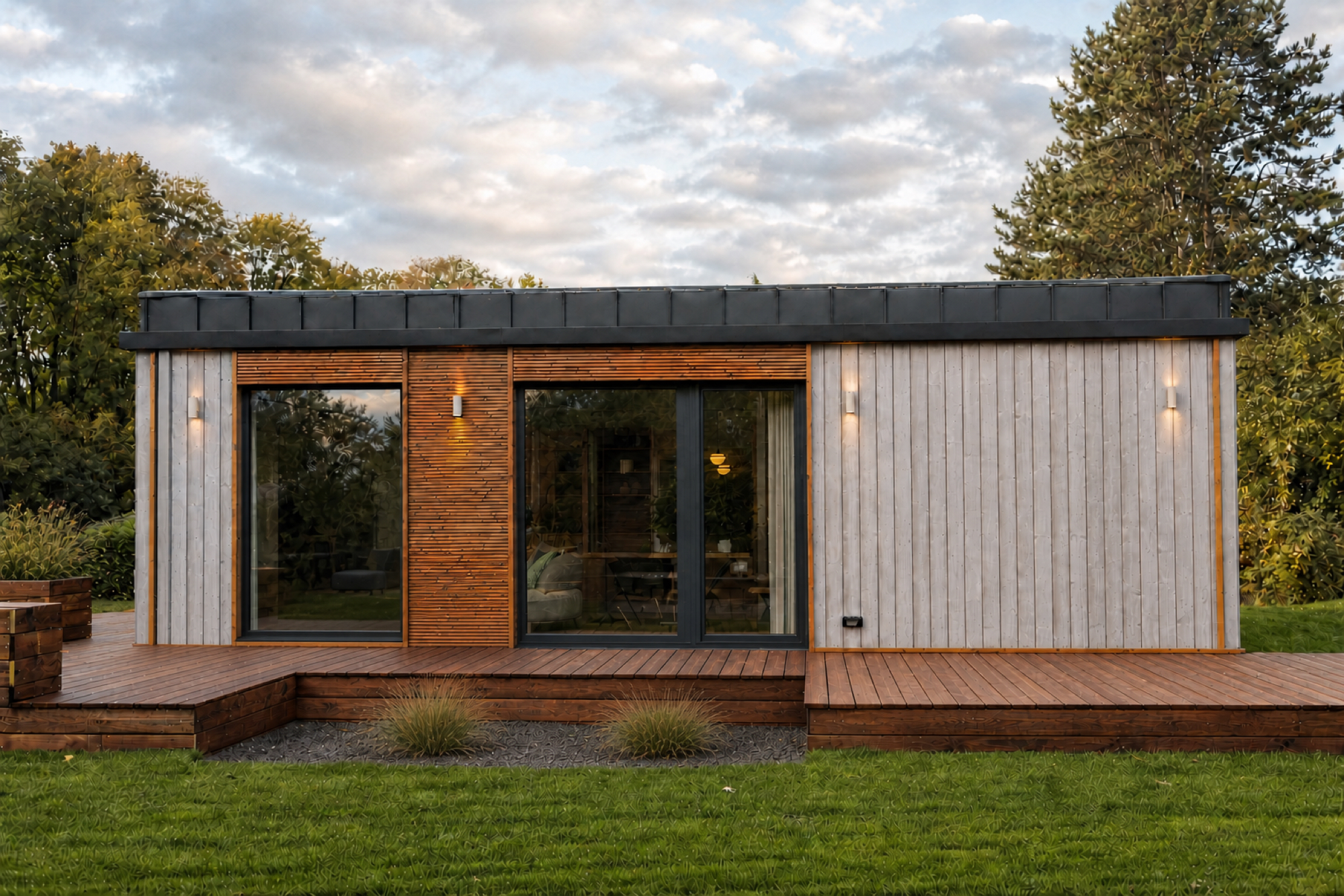
DWELLII houses are eligible for KfW funding and can be built as an Efficiency House 55 or Efficiency House 40 (KfW standards). Whether funding is granted, and how much, is decided by KfW. Everything else in this article is what KfW and the federal ministry say.
What KfW funds
According to KfW, funding for the Efficiency House 55 is part of the programme “Klimafreundlicher Neubau – Wohngebäude” (climate-friendly new build – residential buildings, loan 297/298). According to KfW, it has three funding levels: “Klimafreundliches Wohngebäude” (climate-friendly residential building), “Klimafreundliches Wohngebäude – mit QNG” (climate-friendly residential building – with QNG) and the time-limited level “Effizienzhaus 55 – Wohngebäude” (Efficiency House 55 – residential building).
According to the KfW information sheet (as of 07/2026), funding is provided as reduced-interest loans. KfW gives the maximum loan amounts as follows:
- Efficiency House 55 – residential building: up to €100,000 per residential unit
- Climate-friendly residential building: up to €100,000 per residential unit
- Climate-friendly residential building – with QNG: up to €150,000 per residential unit
According to the information sheet, the product interest rate that applies is the one valid on the day of approval or, if more favourable, the one valid when the application was received; KfW publishes current interest rates at kfw.de/konditionen.
How long does funding for the Efficiency House 55 run?
In its press release of 19 June 2026, KfW writes that the offer can be used “until the federal funds provided have been used up – but no later than the end of the year”. According to KfW, the federal government has extended the funding guideline “until 31 December 2026”.
The Federal Ministry for Housing, Urban Development and Building writes on 9 October 2026: at the latest “receipt of the application by KfW on 31 December 2026”, and only as long as programme funds are still available. According to this announcement, the ministry has topped up the funds.
There is no legal entitlement to the funding.
KfW, press release of 19 June 2026
What KfW requires for the Efficiency House 55 level (extract)
According to the information sheet, the Efficiency House 55 level is reached if
- the requirements for an Efficiency House 55 are met,
- no heat generators based on fossil energy are used, and
- a valid building permit exists at the time of application. For projects that do not require a permit under the state building regulations, KfW says the building authority must be aware of the project and construction must be allowed to begin.
For the “Climate-friendly residential building” level, the information sheet states that KfW requires the Efficiency House 40 plus requirements on greenhouse gas emissions over the building’s life cycle. Further conditions are set out in the information sheet.
How the application works, according to KfW
The order matters. According to KfW, you apply through a financing partner of your choice, such as a bank, savings bank, building society or insurer, and you do so before the project begins.
According to KfW, this is based on the “Bestätigung zum Antrag” (confirmation for the application) from an energy efficiency expert on the list at energie-effizienz-experten.de.
According to the information sheet, the start of the project is generally the signing of a supply or service contract; planning and advice do not count. KfW says that what counts is when the application is received by KfW, not by the financing partner. Contracts with a condition precedent relating to the funding approval do not, according to KfW, count as a project start that rules out funding. KfW says the application must nevertheless be submitted before construction work begins.
For the Efficiency House 55 level, KfW mentions a special rule: if a documented advisory meeting with the financing partner or a financial intermediary took place before the contract was signed, the information sheet states that the project is only deemed to have started when construction work begins on site. For this, KfW names the form “Nachweis eines Beratungsgesprächs” (proof of an advisory meeting). KfW sets out the timing conditions for the advisory meeting in the FAQs on its product page.
Where you can read it for yourself
What KfW writes is binding. Read the conditions directly on KfW’s website and talk to your bank and an energy efficiency expert. We cannot and do not wish to give legal or financial advice here. We cannot promise funding in any individual case; whether the KfW conditions fit your project is something to clarify with your bank and the expert.
If you’d like to know which DWELLII house suits your plot, we’ll be happy to send you a quote. And at the show house in Bad Vilbel, you can take a good look at the TR3M at your leisure.