Warm in winter, pleasant in summer: the heat pump in a modular house
- 73.6%
- of residential buildings completed in 2025 are mainly heated by a heat pump (Destatis)
- 3 to 5
- units of heat from one unit of electricity with efficient heat pumps (Verbraucherzentrale)
- 0.02
- global warming potential of propane (R290) according to Bosch, CO₂ = 1
Winter is when a house shows what it can do. Outside it’s wet and cold; inside it should be evenly warm, without you fiddling with the heating. In new houses, this job is now almost always done by a heat pump. We explain how it works, what matters and how it does its job in the TR3M.
Long since the norm in new builds
The figures from the Federal Statistical Office of Germany (Destatis) are clear. Of the roughly 58,900 residential buildings completed in Germany in 2025, 73.6 per cent are mainly heated by a heat pump. In 2015 the figure was still 31.4 per cent. For new single-family houses, the share in 2025 was as high as 77.9 per cent. Gas is now the main energy source in only 10.5 per cent of new residential buildings (2024: 15.0 per cent).
Looking ahead, the trend points the same way. According to Destatis, 83.0 per cent of the residential buildings approved in 2025 are set to be heated mainly by a heat pump.
How a heat pump works
You know the principle from your kitchen. A fridge takes heat from its interior and releases it outside. According to the Verbraucherzentrale (the German consumer advice centre), a heat pump for heating does the opposite: it brings heat from outside into the house. An air-to-water heat pump uses the outside air for this. A refrigerant carries the heat in a closed circuit, and a compressor raises it to the temperature the house needs.
To do this, the heat pump needs electricity, but far less than it delivers in heat. According to the Verbraucherzentrale, efficient units produce three to five units of heat from one unit of electricity. This is measured by the seasonal performance factor. A heat pump counts as efficient from a value of 3 upwards; according to the Verbraucherzentrale, air-source heat pumps usually reach values between 3 and 4.
Why underfloor heating and heat pumps go well together
A heat pump runs most economically when the heating water doesn’t need to be very hot. The Verbraucherzentrale names flow temperatures between 30 and 50 degrees as a favourable range, and underfloor heating or large radiators as ideal. The reason is simple: a large warm surface gives off heat gently, instead of a small radiator having to get very hot.
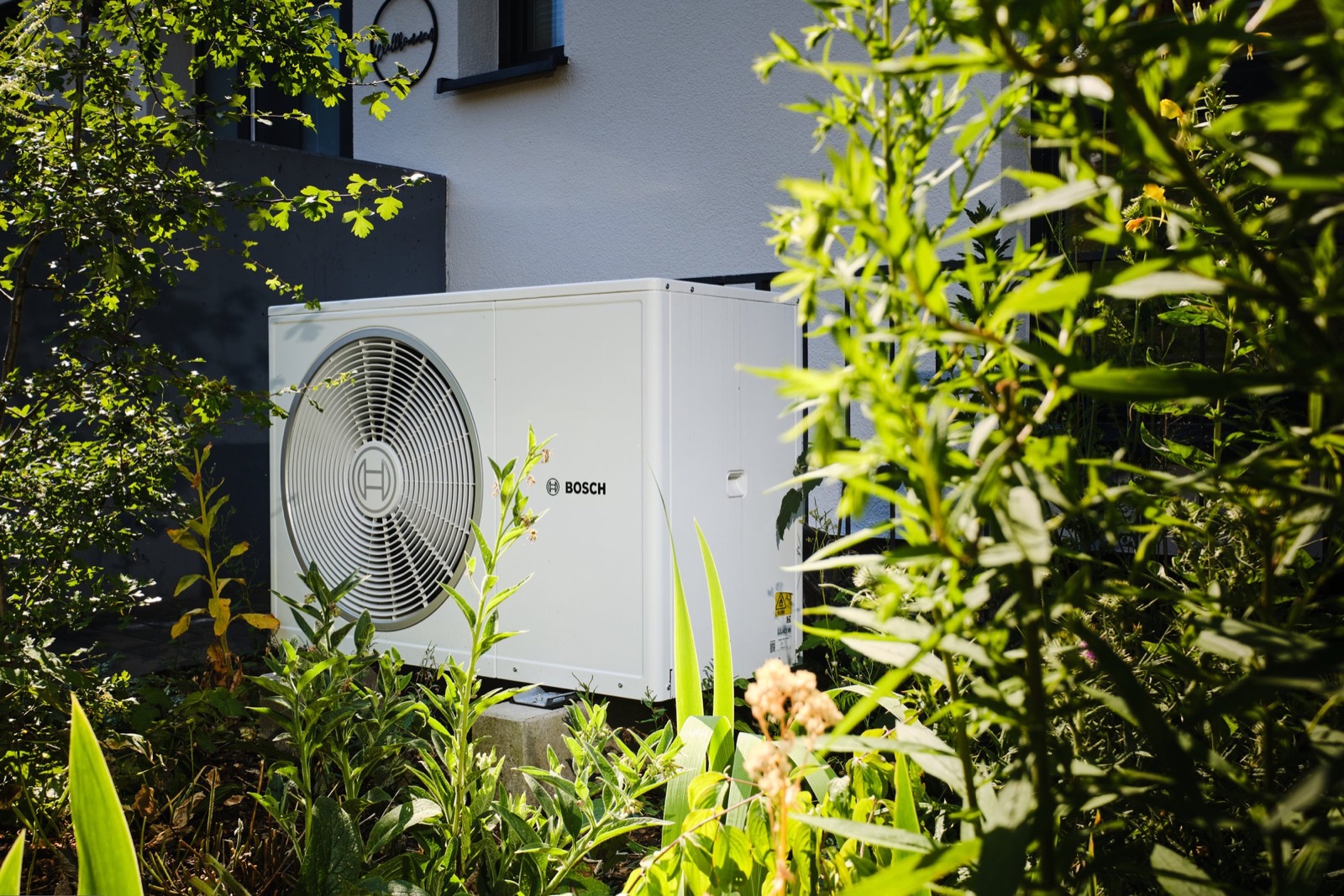
That is exactly how the TR3M is designed. In the TR3M, we use an air-to-water heat pump from Bosch with a natural refrigerant (R290). It supplies water-based underfloor heating, and the hot water cylinder is integrated into the heat pump. You can find out more about the manufacturer’s heat pumps on the Bosch Home Comfort website.
You get this as standard at DWELLII with the Bosch heat pump. It also cools in summer.
Mario Beckstein, DWELLII, in the show house, on the underfloor heating
And in summer?
Some heat pumps can reverse their circuit and cool. The Verbraucherzentrale is honest about this: air-source heat pumps with this function provide active cooling, use more electricity to do so, and bring the temperature down much less than an air conditioner does. In the TR3M, the underfloor heating also cools via the heat pump. On top of that come roller shutters, which are standard at every specification level at DWELLII. You can read how much difference sun shading in front of the window makes in our article on sun shading.
Propane as a refrigerant
Which refrigerant a heat pump contains is no minor detail. If it escapes because of a fault, it affects the climate. According to Bosch, propane, known as refrigerant R290, has a global warming potential of 0.02. For comparison: CO₂ has a value of 1. Older data sheets give a figure of around 3 for propane, because they are based on an earlier report by the Intergovernmental Panel on Climate Change (IPCC). Both values are very low.
Propane is not a fluorinated gas. According to Bosch, the step-by-step bans in the European F-gas Regulation therefore do not affect it. Because propane is flammable, specific rules apply to where the unit is installed. Bosch describes them like this: with units designed for outdoor installation, the hermetically sealed refrigerant circuit is located entirely outdoors, and a protection zone of at least one metre applies around the unit to openings such as basement windows or light wells. Work on the refrigerant circuit belongs in the hands of trained specialists.
Good to know
The smaller houses TR01, TR02 and TR03 are heated differently: there, an air conditioning unit, in other words an air-to-air heat pump, does the heating and cooling, together with electric underfloor heating.
What to bear in mind when planning
An air-source heat pump has an outdoor unit with a fan, and you can hear it. According to the Verbraucherzentrale, modern units have become much quieter. Even so, it advises allowing a few metres’ distance from bedrooms and neighbouring houses. Lawn dampens the sound; corners between two walls amplify it. So where the unit is to stand on your plot is something to settle early in the planning.
The Verbraucherzentrale mentions two more points: you have to register the heat pump with your local grid operator. And if you want to use a cheaper heat pump electricity tariff, you need a separate electricity meter.
That leaves the question of your own power from the roof. According to the Verbraucherzentrale, a photovoltaic system can supply part of the electricity for the heat pump, but in winter the yield is not enough to cover all of it. At DWELLII, PV preparation is always included. You plan the system itself with a partner. The utility connections, which the heat pump also depends on, are installed on site by the electrician and plumber and come on top of the building price.
The KfW (Germany’s state development bank) provides information on funding programmes on its website. Whether and how funding is granted is decided solely by the KfW.
We’ll be happy to show you in your personal quote how heating and cooling work together in your TR3M.
Sources
- Federal Statistical Office of Germany (Destatis): press release no. N038 of 10 June 2026, “Rund drei Viertel der im Jahr 2025 errichteten Wohngebäude heizen mit Wärmepumpen”. https://www.destatis.de/DE/Presse/Pressemitteilungen/2026/06/PD26_N038_31_51.html (accessed 26 November 2026)
- Verbraucherzentrale: “Wärmepumpe: Alles, was Sie wissen müssen”, as of 14 April 2026. https://www.verbraucherzentrale.de/wissen/energie/heizen-und-warmwasser/waermepumpe-alles-was-sie-wissen-muessen-5439 (accessed 26 November 2026)
- Bosch Home Comfort: “Propan-Wärmepumpe” (manufacturer’s information), as of September 2026. https://www.bosch-homecomfort.com/de/de/wohngebaeude/wissen/heizungsratgeber/waermepumpe/propan-waermepumpe/ (accessed 26 November 2026)
- KfW: funding product “Klimafreundlicher Neubau – Wohngebäude (297/298)”. https://www.kfw.de/inlandsfoerderung/Privatpersonen/Neubau/F%C3%B6rderprodukte/Klimafreundlicher-Neubau-Wohngeb%C3%A4ude-(297-298)/ (accessed 26 November 2026)